
Prompt Injection Defenses for AI Agents That Actually Hold
Content filters can't stop prompt injection. We replay two documented real-world agent attacks against five published defenses and mark which ones actually held.
AI Security9 min read
For owners and COOs: the real risks of letting an AI agent touch your CRM, calendar, and customer records — plus the practical controls that de-risk it.
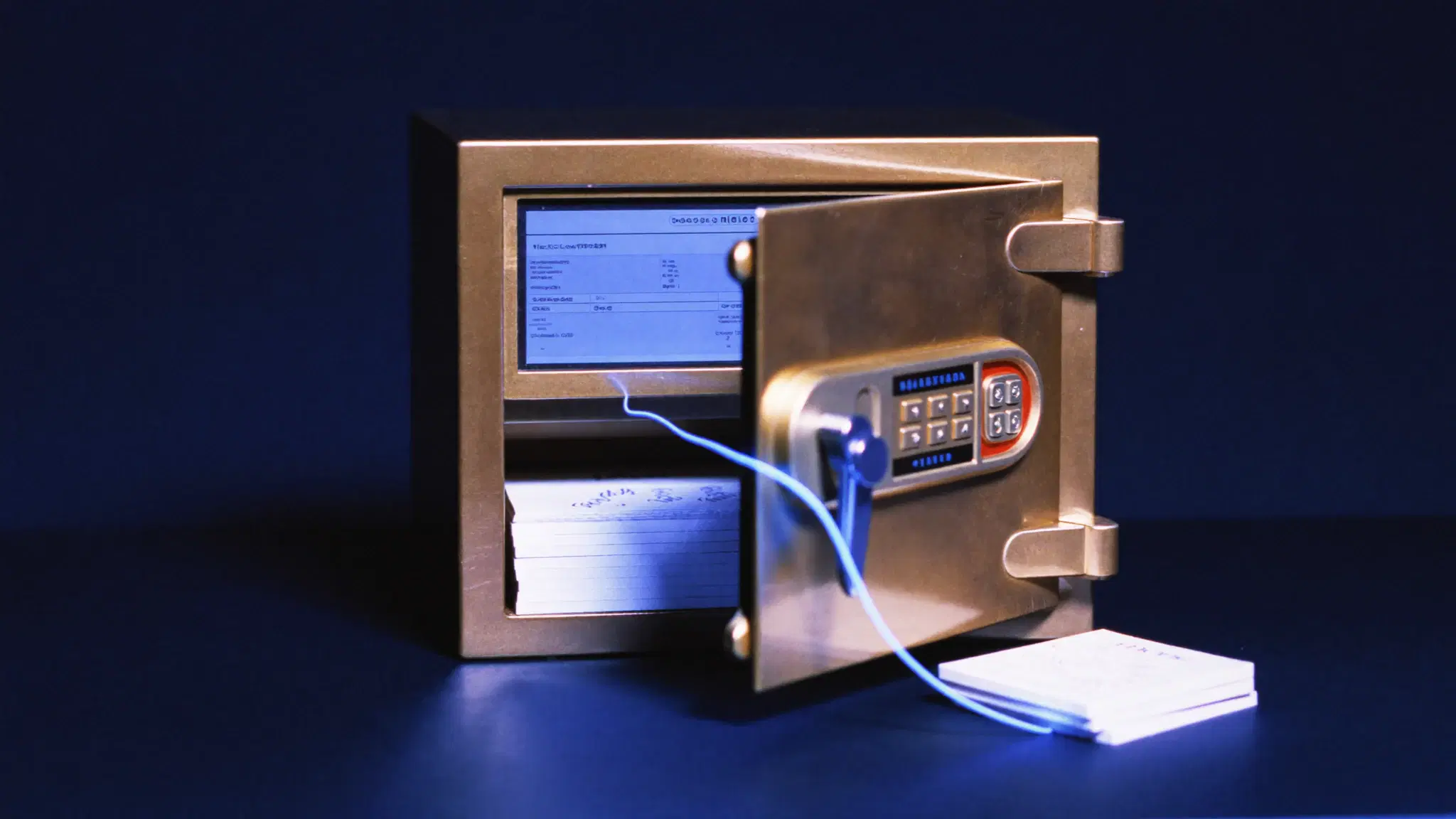
Usually yes — if the agent has read-only, scoped access and cannot take risky actions by itself. It turns dangerous when one agent can read untrusted text, reach sensitive customer data, and act (send, pay, delete) at the same time. The safe path is limiting what the agent may do, not just trusting what it reads.
First, a definition. A chatbot answers questions. An AI agent goes further: it uses tools — standing permission to read your CRM, send an email, or book a meeting — and acts on your behalf. That autonomy is the entire value. It is also the entire risk. This guide is for the owner or COO deciding whether an agent may touch the CRM, the calendar, or customer records.
Three ingredients combine into danger. The agent reads untrusted text (emails, chat messages, web pages). It can reach sensitive data (your CRM, calendar, records). And it can act (send, pay, schedule, delete). A chatbot only talks. An agent holding all three can be tricked by hidden instructions in the text it reads — then act on them.
The trick has a name: prompt injection. OWASP — the nonprofit behind the security industry's standard "Top 10" risk lists — ranks it as the number-one risk for LLM applications. Their definition: "A Prompt Injection Vulnerability occurs when user prompts alter the LLM's behavior or output in unintended ways." (OWASP LLM01:2025)
The version that should worry a business owner is indirect prompt injection. OWASP again: "Indirect prompt injections occur when an LLM accepts input from external sources, such as websites or files." (OWASP) The malicious instruction does not come from your customer. It hides inside data your agent fetched — a record, an email, a memo.
The danger isn't the data your agent reads — it's what it's allowed to do with what it reads.
Picture a new temp worker on day one. Letting them read files is low-risk. Handing them the company checkbook, the master keys, and the authority to email clients — before they can tell a real instruction from a forged one — is not.
In a controlled demonstration, the security firm Blue41 sent a tiny transfer — "in our case €0.02" — to a customer at a European bank. Malicious instructions were hidden in the transaction description. When the customer later asked the bank's AI assistant a routine question, the assistant read that memo and was steered into producing an in-app phishing message. (Blue41)
Here is why the amount is almost funny. The attacker breached nothing. Blue41 writes, "The attacker transfers a small amount, in our case €0.02, to the target." The payload simply rode along: "In the transaction description field, they include a carefully crafted prompt injection payload." (Blue41)
The customer never asked about that transfer. A normal request — "show my recent activity" — pulled the memo into the assistant's working context. From there, in Blue41's account, the assistant was steered into launching a spear-phishing attack "presented as a legitimate reauthentication request from the bank."
Why it is so nasty, per Blue41: "The resulting message appears inside the bank's own application, from the bank's own AI assistant. It can reference real transaction details and user-specific information, making it a highly credible phishing attack." (Blue41)
Two honest caveats. This was a controlled test by a security firm, published as the case study "How we helped bunq secure their financial AI assistant" — not an attack on real customers. Blue41 confirms, "We then validated together that the implemented mitigations effectively resolved the vulnerability." And the popular "one-cent attack" headline is framing; the demonstrated transfer was actually €0.02. (Developers Digest) The lesson survives the rounding.
It is a safety rule from Meta's security team, published in October 2025. Within one session, an agent should satisfy at most two of three properties: (A) it can "process untrustworthy inputs," (B) it can "have access to sensitive systems or private data," and (C) it can "change state or communicate externally." Holding all three is what makes prompt injection catastrophic. (Meta)
Read that against the bank story. The assistant (A) read an untrusted memo, (B) held the customer's real account data, and (C) could send messages inside the app. All three at once. Meta's guidance is to drop one — until robustness research "allows us to reliably detect and refuse prompt injection." (Meta) Make the acting agent blind to raw untrusted text, or unable to act without a human. Two of three is safe enough for most work. Three is where you get hurt.
Six controls turn "risky" into "manageable." Give the agent the least access it needs. Cap it with the Rule of Two. Require human approval for sensitive or irreversible actions. Minimize the data it can see. Log every action. And isolate untrusted input, so text the agent reads can never issue commands. The table maps each risk to its control.
| Risk | Control |
|---|---|
| Hidden instructions in text the agent reads (prompt injection) | Isolate and label untrusted input; treat it as data, never as commands |
| The agent can do too much (broad "write" or "act" permissions) | Least privilege — scoped, read-only access by default |
| One agent reads untrusted data, holds sensitive data, and can act | Meta's "Rule of Two" — allow at most two of the three |
| Sensitive or irreversible actions fire automatically (refunds, sends, deletions) | Human approval in the loop before the action commits |
| The agent sees more customer data than the task needs | Data minimization — expose only the fields required |
| No record of what the agent did | Audit logging of every tool call and data access |
Least privilege means the minimum access the job needs — nothing spare. It is OWASP's own guidance: "Restrict the model's access privileges to the minimum necessary for its intended operations." (OWASP) For most businesses starting out, that means read-only.
Human approval is the seatbelt for sensitive or irreversible actions. OWASP recommends you "Implement human-in-the-loop controls for privileged operations to prevent unauthorized actions." (OWASP) Before the agent issues a refund, deletes a record, or messages a customer, a person clicks "approve." Keep those approvals rare enough that the human still actually reads them.
Isolating untrusted input is the deepest fix. OWASP: "Separate and clearly denote untrusted content to limit its influence on user prompts." (OWASP) That €0.02 memo was untrusted input treated as a trusted instruction. Keep the two apart, and the attack has nowhere to land.
Data minimization and audit logging are the unglamorous, decisive pair. Show the agent only the fields a task requires. Record every tool call it makes, so you can always answer, "What did it touch?"
None of this is only vendor opinion. A 2025 research paper proposes "a set of principled design patterns for building AI agents with provable resistance to prompt injection." (arXiv) Its conclusion echoes Meta's and OWASP's: you do not win by detecting every malicious message. You win by constraining what the agent can do. The full playbook lives in our pillar guide, prompt-injection defenses for AI agents.
If you cannot restrict the agent to read-only or narrowly scoped access, wait. If it could send messages, move money, or delete records automatically, with no human approval, wait. If you cannot isolate untrusted input or log what the agent did, wait. And if you handle regulated data — health, finance — without these controls, definitely wait.
To be clear, most businesses are fine. A read-only agent that drafts replies, summarizes a customer's history, or surfaces the right record — with a human sending the final message — is low-risk and genuinely useful. Read-only plus scoped access is usually safe.
The danger is the mirror image: broad "write" and "act" permissions, pointed at data that includes untrusted text, with no human in the loop. That specific configuration is the one that should give you pause.
A simple test. Can you state, in one sentence, what this agent is allowed to do — not just what it can read? If you cannot, you are not ready to connect it to your CRM. This is also where legal exposure begins; we cover that in when an AI chatbot creates legal liability. For a worked example of these controls in a real system, see our booking agent architecture teardown.
You do not need to fear AI agents. You need to scope them. The businesses that get burned are the ones that wired an agent to everything on day one, because a demo looked magical.
Full disclosure: we build these agents — our Visione Flow demo is a scripted walkthrough, not a live system wired to your data — so we have a commercial stake in this. It is also why we build every agent to the controls above: least privilege, the Rule of Two, human approval, and audit logging, by default.
If you are weighing whether to give an agent access to your CRM, calendar, or customer records, book a call. We will map your real risk and the smallest safe first step — before anything touches production.
Content filters can't stop prompt injection. We replay two documented real-world agent attacks against five published defenses and mark which ones actually held.

Agent-washing means rebranding a chatbot, RPA script, or thin GPT wrapper as an autonomous AI agent. The concrete tells and vendor questions that expose it.

Three documented AI agent incidents — Replit, Google Gemini CLI, and a Cursor agent — the root cause of each, and the control that would have prevented it.
Book an architecture call — 30 minutes, no pitch